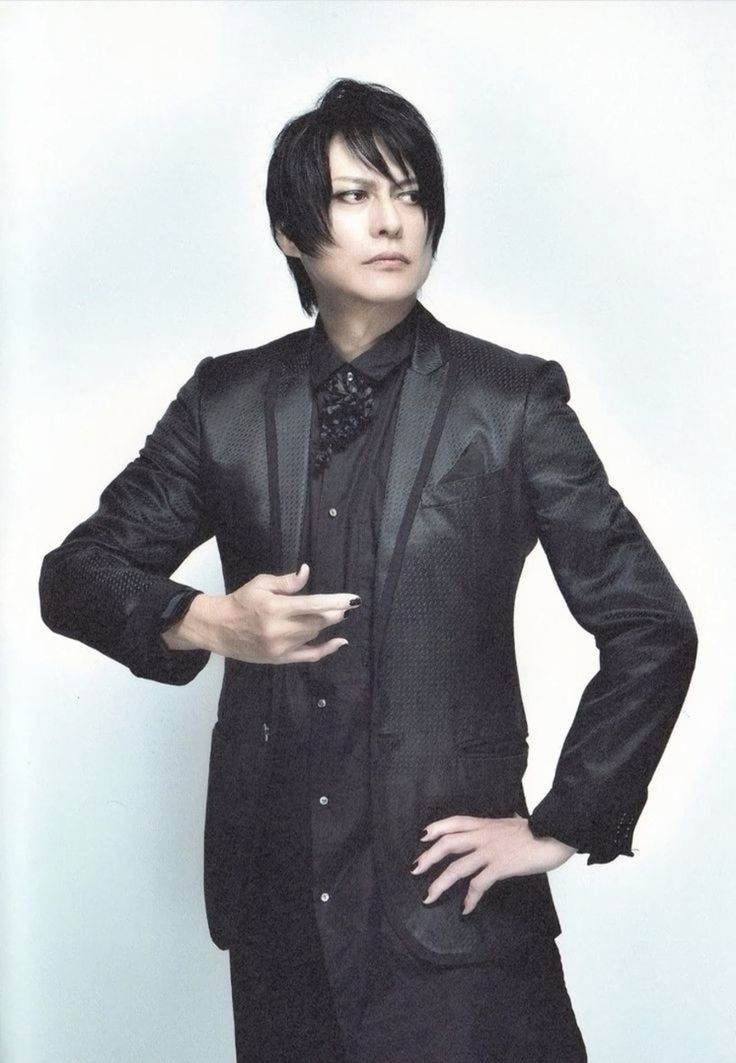
On March 6, 1966, one of the most legendary Japanese musicians to be was given life. Unfortunately, he wouldn't be able to tap into his creativity or passion for a very long time: restricted by the forceful hands of an abusive, unforgiving father, a struggling mother, and a brother none the wiser to how his parents are harming them, Atsushi was never quite able to enjoy his childhood.
He's quoted himself as a timid and insecure boy, often playing alone or with the girls. His solitary tendencies remained constant throughout the entirety of his life. By secendary school, he had grown rebellious and angry. He didn't really have anything in life he was able to enjoy or yearn for, so he lived recklessly. He hung around gang friends and got into trouble, was had no control over his emotions. He was cold to his peers and reserved. (He would eventually leave his little gang after getting into trouble with the police, at the request of his beloved mother). This was one of the lowest points in his life.
In high school, Atsushi found his way into joining a band some of his classmates were in. He offered to play the drums and resorted to practicing at U-ta's house (his own father couldn't stand him practicing at home). The band slowly got more serious, and Atsushi switched from the drummer to the singer (since their singer got the boot). Atsushi cites his desire to be the vocalist as, "one of the first things he ever really wanted to do"; he had to beg the other members to let him take the role. When he did, he absolutely flourished.
In 1984, Atsushi graduated high school. It was in this year that his father passed away. Around this time was when I believe Atsushi started to copy him behavior-wise—of course his father's tendencies had bled into his own, but he begun to spend his time drinking and not doing much of anything at all. As time would erode on his mind, he finally built up the gaul to leave his dear mother and brother alone (his father had passed around when he graduated) in hopes of making a life for himself as Buck-Tick's musician in the city.
In the early days of their career, the members were hardly scraping buy. Money was less than scarce, and what they did have went back into the band/booze. Despite their horrendous conditions of living, they managed to grow as a band pretty fast. Atsushi (in Toll's words) took to his role as frontman like "a fish to water." Although he was far from being in his best headspace, his new lifestyle seemed to be a breath of fresh air. He and his friends were just 5 kids with a dream.
Everyone in the band was dedicated to making a name for themselves: all of their time and energy was put forth into the band in some capacity. By 1989 or so, their efforts had paid off—their time used to go into all into the band because every hint of publicity mattered, but they had achieved success so great that now they hardly had a choice! Shows were everyday and they were busier than ever before. Even proceeding Imai's arrest, the band was so successful that they continued to play like nothing had even happened (unheard of in Japan). This was the year Atsushi seemed to try experimenting more with his lyricism; he began to incorporate more evocative and interesting ideas into his poetry, showcasing gothic inspiration. He was an interesting guy, but his demeanor towards art felt very performative: he was still just a rebelious kid trying to make it big, in my humble opinion.
In 1990, tragedy struck. He had truly started expanding on his gothic interests during Aku no Hana, when his mother passed away. Being accross the country due to touring, his last conversation with her was on the phone (inspiring their 2002 song Long Distance Call). This was what I and many other fans consider to be one of the most life-changing events he ever endured. He had always been a troubled individual full of dormant ardor, and this loss seemed to awaken something. He was exceedingly close to his mother: in a desperate frenzy, he began to research religion. He wanted to believe that his late mother had gone somewhere.
I'm under the impression that his mother's death is what truly sparked his interest in metaphysics. When he began to research theology, he spiraled. Not only did he develop an overwhelming fear of death. He began to dread mortality, a phobia that overtook the majority of his time: he'd shake by night and writhe by day. He expressed this sentiment throughout the entirety of his life. These two focuses blended into a beautiful outcome: his career would be marked by his consistent writing about Love and Death. While he learned of theology, that would lead into history, and into sociology, to psychology, to philosophy, et cetera. He quickly grew rather enlightened, taking a particular interest in mortality, madness, sex, humanity, experimentation, and the like. He grew to value poignancy and his love for art blossomed. This is around the time his lyrics began to sound like poetry, because that's what they were: he'd study old, traditional Japanese haikus. If you couldn't tell already, he was improving upon himself exponentially.
I'd like to say that when he began to educate himself is also when he bettered himself as a person. He struggled with terrible depression, PTSD, etc. throughout his entire life, but that turmoil manifested in the form of violence in his early youth. He's admitted being ashamed of the fact he was careless and rude when he was young. While I believe you should never assume any musician to be trustworthy/a good person, most fans agree that it is pretty safe to say Atsushi was very, very kind. He expressed a desire to grow "even kinder" continuously for decades, and almost every time any fan/interviewer/musician has ever spoken about Atsushi, they all say he's "extremely kind, shy, and reserved," as well as an "extraordinary vocalist." I think it'd make sense that it was around the time that he began to enlighten himself that he started to reevaluate his behavior.
In 1991, Atsushi changed the kanji of his last name. His name has, since then, been spelled 櫻井 敦司 (Sakurai Atsushi), but the 櫻 was previously 桜, the older version for "sakura."
This is also around the time his first marriage grew apparent (When even did he marry? 1992? 1518?). Not even a couple years after marrying his first wife, they divorced. She seemed to have left with their son, who would pop up again in an awkward interview with him in 2020. While there are definetly some commonly held beliefs on what went down (that even I subscribe to), this writing wasn't exactly intended to spread gossip or highlight such embarassing blots for him, so I'll stop while I'm still here. I just want to say, thank god he turned his life around completely.
A lot of fans consider Six/Nine—released in 1995—to be the band's first real concept album. I suppose I agree with this notion. While the members began to mature, learn, and improve exponentially in the early 90's (1990-1993 hold some of their BEST releases ever!!!!!!! If you're going to listen to Buck-Tick, start with those albums! It will change your life!). '95 was a sort of stepping stone for them. Six/Nine was a lot more ambitious and nuanced than their previous work, centered around rinne/samsara—the Buddhist cycle of death and rebirth. This album absolutely changed mine and the lives of innumerable other fans. The album delves into human connection, war, love, identity, isolation, and most importantly, death. This album was my first introduction to non-dualism, and has permanently changed how I perceive the world around me.
This was a year of growth for our beloved rockstar (See what I did there?). His improvement wasn't just present in his lyricism, but showed itself in other ways, as well. For example, he cut his hair rather short this year. This doesn't really sound like a big deal: people cut their hair all the time! However, it was a little different for Atsushi. Buck-Tick is known for always doing what's new and experimental, and never sticking to a label—they're restrictions! His hair was a telling example of this. In the 80's, the members stuck their hair up real high. As soon as it became a recognizable feature of theirs, they stopped real fast (with the exception of Toll, who considers it an important part of his stage persona). Atsushi was one of the first. After he stopped putting it up, he stopped dying it and let it grow out. If you've ever seen pictures of Atsushi online, they were most likely of him with long hair in the early 90's. It always pisses me off when people glamorize Atsushi during his long-hair era: it's a picture-perfect example of how aestheticism takes precedence in our society. Everyone loves talking about how pretty he was and how lovely his voice was, but never the depth of his words or the fact that the early 90's were some of the most depressed years of his life, secluded away in his dark room chugging liquor all day, indifferent to his friends and partners. (While I adore that era of Buck-Tick releases with all my heart, this is why I refrain from falling head over heels for them. Falling for superficial beauty is one of the easiest things in the world. Never succumb.) Buck-Tick gained a lot of traction around this time, and Atsushi was known as their "pretty-boy frontman." His long hair was the talk of the town: it made him womanly and even more beautiful. This is why I think him getting a short ass haircut wasn't just because "long hair was a pain in the ass" (in his words). For this reason, some older fans I've spoken to have said this is just another reason that Buck-Tick is apart of the anti-visual movement (It's not actually a movement, per se, but a term given by fans to identify the phenomenon in which Japanese artists would reject defining physical attributes in resistence of being labeled a "visual kei" band. Visual kei was not only an insult around the time (in the same way goth was in the west), but one that encouraged people to shift their focus onto the appearance of bands rather than their musical integrity. Buck-Tick, despite what people say, is definetly one of these bands. They've cleraly stated that they don't want to be labeled as visual-kei due to its restrictiveness, and Toll has even admitted to moving the Buck-Tick CD's in a store to the rock section when he saw they were listed under visual-kei! Buck-Tick may have helped visual-kei in its early run, but to permanently shove them into that boat would just be incorrect.). Not to mention, this was the year Atsushi admitted himself into a hospital for depression. He explained in an interview that he felt like an attention-seeker for talking about it (nooo!), but he had himself hospitalized because his depression was so bad. I know this can be seen as a low point by many, but in my experience, the fact that he understood his issue and willingly sought help is actually telling of his efforts to improve himself.
In 1996, Buck-Tick was in Nepal for a photoshoot when they abruptly had to rush Atsushi to a hospital. He had endured a horrible pain in his side for a good while, until suddenly insisting that he couldn't take it any longer and requested medical help. Atsushi said this was the first time he truly believed he was going to die. The hospitals in Nepal were completely full, so he had to be taken elsewhere: rather than be brought to the nearest open hospital, he asked to be flown to Japan immidiently—if he was going to die, he wanted to do so in Japan. Everyone fought him over it (he was gravely ill and needed professional attention as soon as possible), but he was insistent on traveling back home. He was so ill that he had to be wheelchaired on and off the plane. When he finally arrived home, he was taken to the hospital closest to his home. The doctors declared that he would've passed away had he arrived and received surgery even a day later. This happened to be his first surgery, as well.
Throughout the rest of the decade, not much of anything notable happened in his personal life (that's public information, at least). He got to dabble lots more in solo/side/guest work, but I don't think that should be included in this. This biography is meant to catalogue his more spiritual experiences, not his work-related ones. Even if music was Atsushi's heart and soul, the members have clearly been sure to distinct that music is still their job. They are selling their music, not themselves. It is no "fan's" right to assume to feel entitled to an artist's personal life.
After the hectic touring of '03, Atsushi finally started to "settle down" in 2004. He officially annoucned his marriage to the public, and is even see proudly wearing his wedding ring in the Climax Together -Devil and Freud- concert (which I consider to be a beautiful badge of honor on their history, considering that concert held 1 of 2 moment of silences they have ever asked to be held) of the same year. I don't think it's within my right to disclose anymore information on his family here.
I do think marrying helped him ground himself. As Cayce said, 90's era Buck-Tick would've never allowed the silly, cutesy songs about mermaids and princesses that they've been allowing! When the members began to marry and have children, Buck-Tick lost a bit of that intoxicated, rambunctious, chaotic feeling that made them stand out (but not all of it). Imai is the most telling exmaple of this, but Atsushi was very clear as well. Following his marriage, his lyrics and performances felt even more mature than before—as if he was living a new, grounded way of life that he could enjoy. Marriage and parenthood is an immense responsibility, but one that is worth the work. I like to think this is a bit of what Atsushi meant when he talked about giving to the world, and hoping offer love down to his own child, and down that line, and that one... He started loosening up, and you can really tell by his performances that his view of his work was transitioning from mere work to lifestyle and prowess, as well as the responsibility of those with a voice. I could spend a whole day chatting about how admirable his approach on work, life, and love is. He tackles his duties with a sense of self awareness and humility; his mornings are spent reveling in the new day given to him rather than relenting in hsi troubles.
2004 is also a memorable year as it was the year of solo! I said I wouldn't mention much of his little music escapades, but I felt that this one was significant. He released many singles, which led up to a full album, which snowballed into a 2-day concert (there is a DVD of this). This was a lovely project where Atsushi had all sorts of his little musician friends compose for him, and then he would write the lyrics. His album, Ai no Wakusei, or Planet of Love, is a soothing little Sakurai-esque album on all his favorites: sex, death, love, shame... Love, however, is the running theme of it all. We are all connected by love. He also got to play around with this project, covering some songs he enjoyed. Anyway, Atsushi also acted in a 40 minute indie movie called Longinus and released a little poetry book! Don't get your hopes up, the movie isn't any good; it's just a fun chance for him and his buddies to dabble in film. The poetry book is interesting (and came with a cute DVD), and he also released a short photobook. Nothing revolutionary, but endearing nonetheless.
In the year following, Buck-Tick embarked on their most theatrical tour to date: 13th Floor with Moonshine. I wouldn't mention Buck-Tick's work here, but I believe Atsushi credited Romance as the band's magnum opus, so I thought it was worth highlighting (even if my memory is letting me down, that's still a song that our dearest rockstar is very fond of).
In 2009, we were blessed with Higetsushi: Mr. Sakurai finally decided to grow his beard out a little! He very quickly retreated back into shaving after only a mere couple of months, but every Atsushi fan holds his bearded days close to our hearts.
A devastating earthquake hit Japan's Tohoku in 2011, leaving the country to do nothing but helplessly watch as the aftermath displaced thousands of civilians. Buck-Tick, during this time, sold lots of charity merch in order to donate the proceeds to those forced out due to natural disasters. This is a tradition Buck-Tick would upkeep to this day. There are even little posts by Atsushi here and there of him randomly donating little chunks of wealth to charity after he sold a lot of something. I find it lovely. Anyway, the band dedicated their next album to humanity. Our little nerd obviously had a tighter grasp than usual over this album's creative direction, considering that the limited edition of Yume Miru Uchu had Klimt's Goldfish, which is one of Atsushi's favorite painters. I like to think of this album as a very important part of Atsushi's history with Buck-Tick because of what it stood for. Atsushi, never quite leaving his Buddhist influences behind, spoke of humanity as a united consciousness. He are all one with the Earth, the sky, the stars, and each other. You breathe the same air and bleed the same blood that I do. We are of the same matter, the same molecules, the same atoms. He went as far as to call us, as one mind, a "sleeping baby" on Earth, suddenly awoken and crying aloud when disaster struck. We're full of primal innocence and ought to all love one another. Peace and love, as he loved to say. Yumemiru Uchuu was sonically poetic, refusing to estrange anyone, and encouraging us to offer our solemn hands to our neighbor.
At this point in life, Atsushi was beginning to censor himself less and less. For Christ's sake, in 2014 they released a surrealist/anarchist concept album! You'll see that, soon enough, the days of keeping their lips shut would be over. Dare I say that Atsushi first began to explore himself with tracks like Mudai? Arui wa Anarchy's artistic explicity and philosophical ambiguity seemed to be our first hints of Sakurai's wise bubble beginning to burst, leaving us with a flood from his trove of knowledge.
In 2015, Atsushi embarked on a completely new journey, founding his side project titled The Mortal. This project offered him much more lyrical liberty. He improved his vocal skills by an incredible amount for this project and was ripped out of his comfort zone. I consider this project to be a turning point in his life: this is when he decided to stop censoring himself. He concluded that he was old and well-experienced enough to be able to say what he wanted without fear—although, he never truly stopped being scared of that. The Mortal was very gothic and, obviously, based around the idea of mortality: to ever be born is to be destined to die. We are all connected by that looming factor. None of us, no matter how long you postpone it, will escape death. He sought to express this in his work. The album he released under this title was called I Am Mortal, and it's one of the most self-aware and ingenius albums I've ever been blessed enough to hear. It was meant to encompass the human condition, incorporating references to the masterful works of Shakespeare, the traditional 80's goth style that Sakurai loves so much, Medieval Europe's exquisite taste in fashion and eternal danse macabre art, etc. (Where fiction dissapoints, history will step in!).
Since Kame has yet to add Cayce's article, The Cacophony of Mortality to the official reupload of NGS yet, I would absolutely reccomend you read this article if you've any interest in reading more about The Mortal. It's an excellent read.
Following 2015, our dearest Sakurai wasn't willing to just throw away all his revolutionary improvement! He took very strong creative control over their next album, Atom Miraiha No.9, to an extend only comparable to the masterful Kurutta Taiyou of '91! Atom is infamous for bringing back Buck-Tick's cynical awareness of the 90s, but from a state of maturity. They'd lived much longer by 2016, and their experience wasn't going to waste. Atom's stark premonition is incredibly worrying, confronting the right we—as a species—have to science. We're a primitive species, often succumbing to primal desires of recreation, reporduction, and power. Technology has only hurt us, blessing the most treacherous of hands with otherworldly power. Atom tells many poignant tales of loss at the hands of nuclear warefare, radiation poisoning, etc. Imai paints the scene of post-war tragedy, and we viewers get to run with it! The world is your oyster! If you're interested in reading more about what I'd consider one of Atsushi's most philosophically and artistically advanced projects, I'd reccomend reading more of another one of Cayce's articles: Atom Miraiha No. 9: Album Review and Tour Report. Any old save on the Internet Archive of Not Greatest Site can get you there if the link doesn't work. Happy reading!
Something I'd like to add is that Atsushi's newfound self expression was all the more prevolent in his fashion. He's always had a very specific taste, mixing the simple, messy, and traditional style of goth with a more lacey, romantic, provocative one. Most people I know tend to really prefer one or the other, but Mr. Sakurai harnessed his time in the 80's and blended it with his love for elegance. In 2016, he began wearing thigh-high boots ang socks, lace stockings, skirts with long slits, etc. He'd always been one to utilize femininity, but his style truly became his own. Just look at his tour outfits in 2022 and you'll know what I mean.
While moderninity in Buck-Tick's post-2000s works may dissapoint (as the kings of dramatic, catchy, short, and sweet art) at first, I'd like to add that they (Atsushi) really seemed to develop a knack for subtlety around this time. Things don't have to be obnoxious to be emotional: meaning can be symbolized through color, repition, body language, and the like. If you find yourself watching any of their post-2015 work, avant-garde dramatics is noticable occasionally, but notice the simplciity of it all. This decision was deliberate. The Mugen Loop and New World music videos are pivotal examples of this.
We're on a damn roll now! Fast-forward to 2018 (studio-wise, of course, because no sane fan would omit The Day in Question 2017 tour from their catalogue of favorites) and you'll find the band already on another musical adventure! While the last album was a cry for the end, this No. 0 is a steampunk (and steampunk, it is) call for rebirth (Buck-Tick are turning into little numerologists...). The cycle completes amd then restarts, bound by the same old problems and habits, but with hopes for a better world. No. 0 is sometimes credited as the band's most ambitious and experimental album to date in terms of music, so much so that other fans seem apprehensive to even discuss the album with me! The band explores literature and art much more obviously than ever before (Arui wa Anarchy is calling!), with Imai's blunt reference to alleged yaoi literature authors juxtaposing Sakurai's bleak Shakespearean and biblical characters. No. 0 serenades us while Atom grabbed us by the collar. What an experience!
The day after they recorded the tour footage, Atsushi Sakurai became ill with internal bleeding while on stage. I believe the staff encouraged him to go see a doctor during pre-encore intermission, but he refused and said he would've regreted doing so. So what did our beloved Mr. Sakurai do? He continued on, performing the entire encore with gastrointestinal bleeding, and then went to the hospital. All more the reason to never doubt his determination when it comes to singing! After a couple weeks, the band was back up and touring again. He also voiced as a guest in Neko Kikaku.
2019 didn't bring us any new albums, but a couple cute concerts. Shortly, Mother Nature would smite us yet again. With Covid-19 bleeding across the globe, Buck-Tick had to cease their events! This didn't stop them from recording an entire new album, but they would be declined whenever they tried to kickstart a tour. Being cooped up certaintly refreshed their harmonic senses, though, with Abracadabra, Datenshi, and the prerequisite Kemonotachi no Yoru / RONDO arguably being some of their best releases in years. Abracadabra is a charming piece, depicting none other than the iconic Lucy in the Sky with only one Diamond!
Since they couldn't do any concerts (although they managed to slip in a few), they decided to harness the available technology and stream of a couple of concerts, which were later released. This also started the tradition of streaming past releases every week, streaming old concerts for just a couple hours every Saturday. This is something they still do every once in awhile: I remember the 2024 February livestreams very, very fondly. This was also the year that Atsushi's son was officially stated to be Haruka Tono, an award winning author. They had an interview together that was released in a magazine (the interview was so popular that the magazine went into a third printing), and it was stated that the two had been in contact recently. This was pretty big news; everyone had been wondering what happened to that song from, oh, so long ago!
2020 brought us the beloved SWITCH interview, where Atsushi spoke with Hiroshi, a Japanese musician who runs a YouTube channel about solo camping. This was unusual; even in the interview, Atsushi says himself that he doesn't show up on TV often. He's always been a private person. Despite that, he gets pretty personal here (which is why this is a fan favorite!). It's a lovely watch. Around this time, Mr. Sakurai was absolutely dying to perform. They'd been off the stage for years due to the pandemic, and singing was his lifeblood. The band was supposed to venture on another tour in 2021, but Imai fractured his ankle! Only 2 shows were able to be held this year: the Show After Dark shows. Sakurai especially gave his all and it shows. These are actually 2 of my favorite concerts of theirs. The setlist and theme, effects, cinematography, etc. was just outstanding. I don't think they could've done any better. Even as someone who wasn't a big fan of many of the songs, they made it work. Not to mention, Atsushi's stage precense was phenomenal. Fans almost had time to forget how elegant and captivating of an artist he was.
His wish was granted come 2022: they embarked on the Fish Tanker's Only tours! Again, these were some absolutely amazing concerts. They pulled out some older songs noone had anticipated them playing, and did so with grace and skill. He also caught covid (again?) in 2022. Anyway, lots of touring in 2022, as they were also on tour for their 35th annyversary! For this, they made sure to release compilation albums and the like. One very busy year.
Then came 2023. Many lovely little singles were released, anouncing the up and coming Izora. This album would be a very nostalgic experience for the members, fans, and staff alike. This album was jam-packed with esoteric references, symbolism, etc. that most of fans are too scared to even try grasping. Many feel like this album was the epitome of Buck-Tick: it holds catchy melodies, tunes and hymns that take time and dedication to appreciate, mature and ambitioous love, and all sorts of musical and lyrical factors that shouldn't work together at all, but somehow did. It is beloved by those who love Buck-Tick for being incredibly artists and people who improve upon themselves, while often overlooked by fans who enjoy Buck-Tick simply for the musical expererience. This album is as Buck-Tick as it gets.
Despite yearning to return to the stage for years, our beloved Sakurai found himself incredibly worn out this year. After extensive touring for their 35th annyversary, the Fish Tanker's Only tour, and the Izora Tour, he was incredibly burnt out and tired of the stage. Regardless, he continued to sing out of respect for everyone else and a sense of responsibility, all the way until his last breath. Most people don't may it much attention, but I like to think of the Izora Finalo Live Album to be just as memorable as Izora itself. Being his last recorded and released performance (not including the to-be-mentioned Zekkai), it was a lovely display of his skill, passion, personability, and maturity onstage.
His dear, dear friend Issay passing away this year certainly did not help his mental state. Despite everything, he kept on singing. Sakurai said for himself that he understood that his fans were counting on him, and that it was his responsibility to give them the best experience he could. Being an artist doesn't mean lazing about. One night, October 19th of 2023, he was performing at a fan club concert as usual. He sang the first song, Scarecrow, subpar to how he usually does. Despite infamously being the king of vocal control and dedication in Japanese Rock, he couldn't even hit the notes! The song, Boy Septem Peccata Mortalia, rendered him barely able to stand up. He sat down while he sang: mind you, he sits down frequently during concerts, but only to further the theme of the song. It is a performace—theatrical, even. He will sit for songs like Rain, Iconoclasm (ver. 2021), Romance, etc. But sitting for all of Boy wasn't fitting at all. For the third song, Zekkai, which has been recorded and released, we're able to see that he was incredibly unwell. None of his usual dancing (especially for a song so dear to his heart), clapping, meandering... He simply stood, clinging onto the microphone stand for support, and sung with strain. After that one, it was clear he was unable to continue, and he was escorted to the hospital. He escaped our world at 11:09, ending his life in song.
I've always been a firm believer that the words of big companies and celeberities are absolutely useless (crediting his fame to his "unique voice and handsome face" is probably the worst way he could've been characterized by the National News, and a picture-perfect example of exactly what he wished against), but I do think it is notable that his death awoke a side of the Japanese Rock scene that had been asleep for quite awhile. People all across the world were stirred by the news, and many notable artists spoke up to offer condolences (or so crudely self-advertise). A massive ceremony was held and tens of thousands of fans attended, proceeding a private funueral that consisted of family, friends, and close collaboraters of him. Tsuchiya's account of the funueral gives a very clear glimpse into it. He was awared a Lifetime Achievement Award the December after his passing.
Atsushi wanted to sing until his 70's like many artists he loved, but he was taken away before he ever got the chance. Could he have lived had he not prioritized his fan's experience over his health? What if he had not smoked and drank so much in the past? Was this avoidable? Everyone loves asking questions, but I say they're spinach, and to hell with it. Learn as much as you want, but the past cannot be rewritten. He wanted to sing until he died, and that's exactly what he did. All we can do is appreciate that he ever lived. Be thankful for the good that he was blessed. Although he certainly faced hardship like few others, his lived an incredibly fortunate life. Our mothers birth us, we grow up, we love, we die, and then we are reborn. I hope his wish was granted, and that he is getting to experience all of the love over again. Perhaps Imai is right; maybe he is up there drinking wine on a cloud, singing to us and urging us forward. Always remember to honor the past, change for the future, and love your sorrowful enemy. The parade will go on.